mincai.com

Selecting the appropriate laminate tube packaging for your product is a systematic process that requires comprehensive consideration of product characteristics, market positioning, regulatory requirements, and cost-effectiveness.
Below is a clear decision-making framework and key steps to help you make a scientific choice.
I. Core Decision-Making Framework: Analysis Across 4 Key Dimensions
Dimension 1: Product Characteristics (The Starting Point for Technical Selection)
1). Nature of the Contents**:
Acidity/Alkalinity/Corrosiveness:Products like fluoride toothpaste or fruit acid skincare items require corrosion-resistant inner layers (commonly PE or special coatings).
Oil/Solvent Content: Products like hair dye or adhesives require leak-proof, solvent-resistant materials (e.g., EVOH barrier layers).
Active/Sensitive Ingredients:Products like Vitamin C serums or certain ointments require high barrier properties (aluminum foil or silicon oxide coating layers) to prevent oxidation and efficacy loss.
Viscosity:Ranging from fluid serums to thick creams, this determines the tube head size, wall thickness, and the potential need for specific pump heads.
2). Filling and Preservation Conditions**:
Does it require hot filling (e.g., some food sauces)? Materials must withstand heat.
Does it require light protection? Opt for opaque structures or those containing an
aluminum layer.
Shelf-Life Requirements: Longer shelf life demands higher barrier properties.
Dimension 2: Market and Brand Positioning
1). End Price and Cost Control:
Mass-market FMCG (e.g., standard toothpaste) → Prioritize **cost-effectiveness**, traditional aluminum-plastic composite tubes are suitable.
Mid-to-high-end brands(e.g., skincare, health supplements) → Can invest in **all-plastic tubes, matte finishes, special printing effects** to enhance perceived quality.
2). Shelf Presentation and Consumer Experience**:
Appearance: Need vibrant colors, metallic sheen, or transparent windows? Choose corresponding printing techniques (e.g., gravure, digital printing) and materials (transparent films).
Usage Experience:Is there a need for precise dosage control (tapered nozzles, twist-lock caps), standing functionality (flat-bottomed base), or **hygienic sealing** (easy-tear membrane + inner cap)?
Environmental Image:If the brand emphasizes sustainability, **mono-material recyclable tubes (e.g., all-PE), bio-based materials, or tubes with recycling logos** become significant selling points.
Dimension 3: Regulations and Compliance
Regional Regulations: Do target markets have mandatory environmental requirements (e.g., EU SUP Directive on recyclability)?
Industry Standards:
Food: Must comply with food contact material standards like FDA, EFSA.
Pharmaceuticals/Medical Devices: Must meet GMP requirements; materials need biocompatibility, potentially requiring relevant certifications.
Cosmetics: Follow national cosmetic regulations, e.g., China's *Cosmetics Supervision and Administration Regulations*.
Certification Requirements: Is there a need for certifications like FSC (Forest Stewardship Council)?
Dimension 4: Supply Chain and Operational Feasibility
Compatibility with Filling Equipment: Tube dimensions, shape, and rigidity must match existing filling lines.
Minimum Order Quantity (MOQ) and Lead Time: New designs or special materials may have higher MOQs and longer lead times.
Supplier Capabilities: Evaluate the supplier's R&D strength, quality consistency, compliance documentation support, and sustainability commitments.
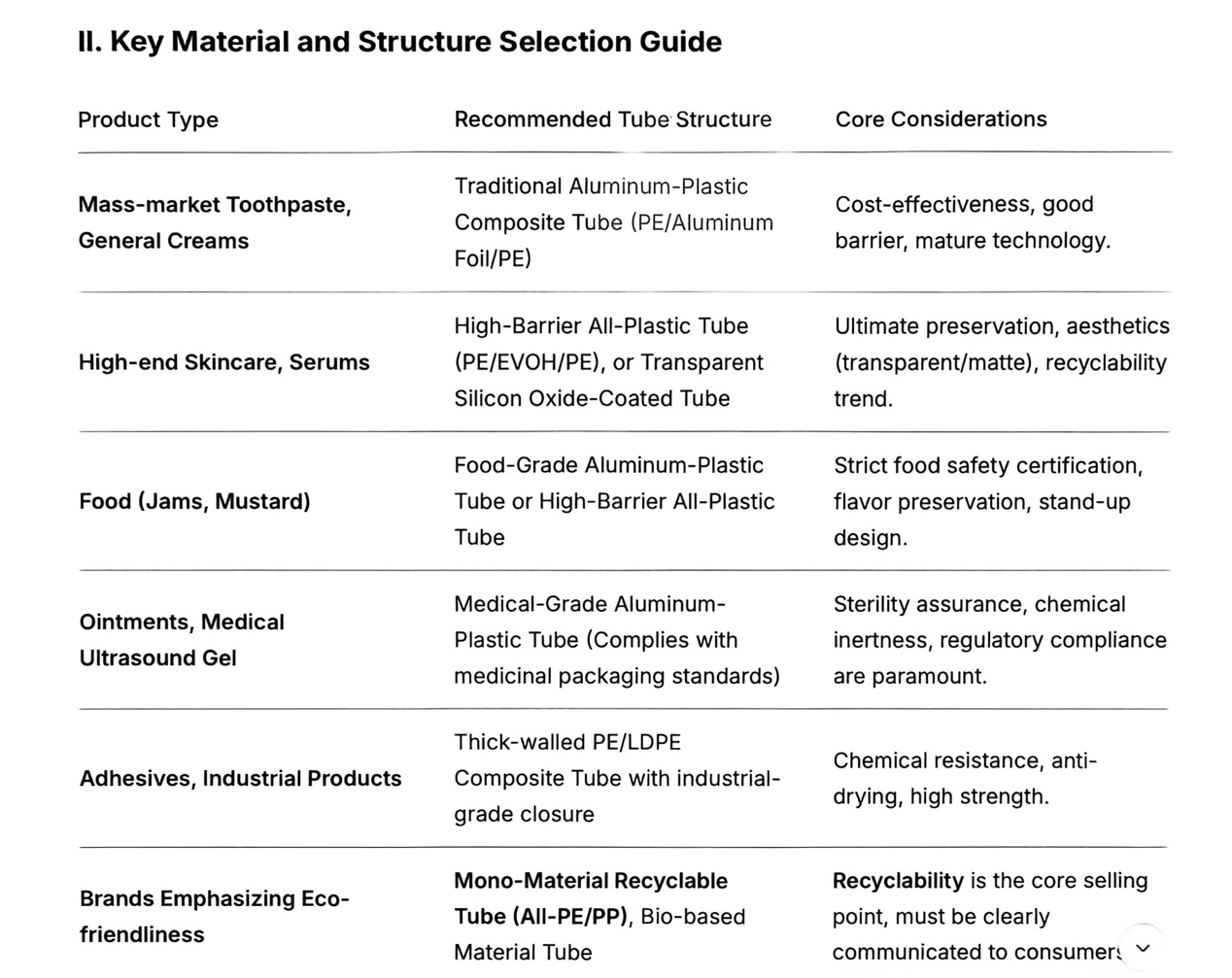
II. Key Material and Structure Selection Guide
III. Practical Decision-Making Process
Internal Assessment:
1). Define product formulation, target shelf life, filling process.
2). Determine brand positioning, target selling price, and environmental commitments.
3). Understand the regulatory environment of target markets.
Deep Collaboration with Suppliers**:
1). Provide Samples: Send product samples to 2-3 reputable tube suppliers for compatibility testing (ensuring no reaction, no migration).
2). Request Prototypes & Testing: Conduct filling tests, drop tests, shelf-life aging tests after receiving physical prototypes.
3). Discuss Sustainable Options: Inquire about available eco-friendly material options (e.g., PCR content, recyclable designs) and their cost implications.
4). Review Compliance Documents: Request material safety data sheets, food/pharmaceutical contact certifications, etc.
Comprehensive Decision & Validation**:
1). Cost Analysis: Calculate the total cost of ownership per package (including procurement, filling efficiency, shipping, and potential brand value-add).
2). Small-Batch Trial Production**: Conduct a small-batch pilot run before full market launch to validate the entire supply chain and gather consumer feedback.
3). Maintain Iteration: Packaging technology evolves rapidly. Regularly review options with suppliers to identify better, more sustainable solutions.
Final Recommendations:
There is no "best" tube, only the "most suitable" tube. Successful selection is the precise balance between product characteristics, brand value, regulatory requirements, and cost structure. It is advisable to incorporate sustainability as a long-term strategic consideration, as global regulations and consumer preferences are rapidly shifting in this direction. Establishing partnerships with leading suppliers possessing strong R&D capabilities is key to addressing future challenges and accessing innovative solutions.
2026 Mincai Group, All rights reserved.